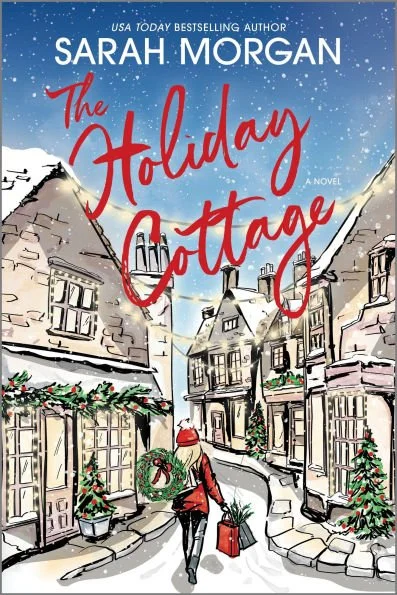
I picked up The Holiday Cottage expecting exactly what the cover promised, a cozy Christmas escape, maybe some light romance, definitely something I could breeze through without much thought. And on the surface, that's what I got. The story follows Imogen, a burned-out professional who ends up at a holiday cottage and stumbles into unexpected family connections. It's sweet, it's comforting, and these kinds of holiday reads aren't really supposed to make you think too hard.
But this one stuck with me. Days after finishing, I kept coming back to it, thinking about burnout, about mother-daughter relationships, about my own experience with independence and how our culture sometimes confuses it with just being alone.
Here are the things that stuck with me:
On mothers and acceptance
The relationship between Imogen and her self-absorbed mother, Tina, resonated with me in an uncomfortable way. There's this specific kind of sadness that comes with realizing a parent just is who they are. That no amount of questioning or fighting or silent hoping will reshape them into the guide you needed. More often than not, people change for themselves, not for us — not even for their children.
I'm not a mother yet, but I think about this, how motherhood should maybe undo some of our self-absorption. Not to erase who we are, but to shift the focus to genuinely care about your child's inner world while still being a whole person yourself. That balance is delicate, and it's one Tina never figured out. Watching Imogen navigate that made me think about how many of us are still waiting for a parent to become who we needed them to be, and what we might build for ourselves if we accepted that it's just not going to happen.
The freedom we find in connection
Right now, our culture really celebrates independence. Being self-sufficient, not needing anyone, doing it all on your own - that's supposed to be the goal. But Imogen's story shows how that thinking can trap us.
When you're alone, you don't have to share your mistakes with anyone; you don't have to make room for someone else's needs or risk being truly seen. There's something that feels like freedom in that, or at least I've told myself that before. But what Imogen finds — and what I'm slowly learning — is that actual freedom comes from the opposite. It comes from telling someone the truth and having them not use it against you; from being accepted as you actually are, mess and all, not just the polished version you show the world.
Independence is useful. But isolation that we've dressed up as independence? That's just loneliness. The difference matters.
When rest becomes the actual success
I read this quote recently, "Your best is what you can do without harming your physical and mental health. Not what you can accomplish when you disregard it." It made me think of Imogen, and honestly, of myself too.
We've somehow decided that burnout proves you're trying hard enough; that exhaustion is a credential; that ignoring what your body is telling you is just part of being professional. Society really drills this into us. But Imogen shows up at this cottage completely drained, and that exhaustion forces her to actually stop and take a break. It's that pause — that space away from everything — that lets her hear what her newfound family is telling her. That, lets her be open to unexpected connections and to see her life clearly enough to want something different.
I kept thinking, what if she'd still been in the thick of work mode, racing between clients and projects? Would she have been open to any of this? Or would she have shoved the whole experience into the "never thinking about this again" part of her brain? Probably the latter.
COVID let some of us experience this for a while; that maybe preventing burnout is its own kind of success, maybe even a quiet rebellion against how things are "supposed" to be. But I can feel that pressure creeping back in. This book felt like a gentle reminder that rest isn't laziness. Sometimes it's the only way to become different than you were.
Other thoughts
Some other reviewers mentioned the book feels rushed toward the end, with way more time on the setup than the resolution. I see what they mean. I actually loved the long beginning because it let me really get to know Imogen and understand who she was before everything changed. But the second half could have used more room. I wanted more time with the family members, more depth in those new relationships, maybe even a glimpse of what happens after the holiday without going full sequel mode.
It doesn't need another book, but it needed a more complete ending, something to ground the changes we watched happen.
Should you read this?
The Holiday Cottage isn't going to change your life. But it might shift how you're thinking about the life you already have — the relationships you've written off, the independence you've convinced yourself equals freedom, the way you've been treating exhaustion like an achievement.
It's exactly what it promises to be, a cozy read. But it's also more than that. It's the kind of book you pick up to escape and put down feeling unexpectedly understood. If you're the type who reads not just to hit a number but to actually think about what it means to be human, there's more here than the pretty cover suggests. Just maybe read it when you're not in the middle of your own burnout spiral, you'll catch more.