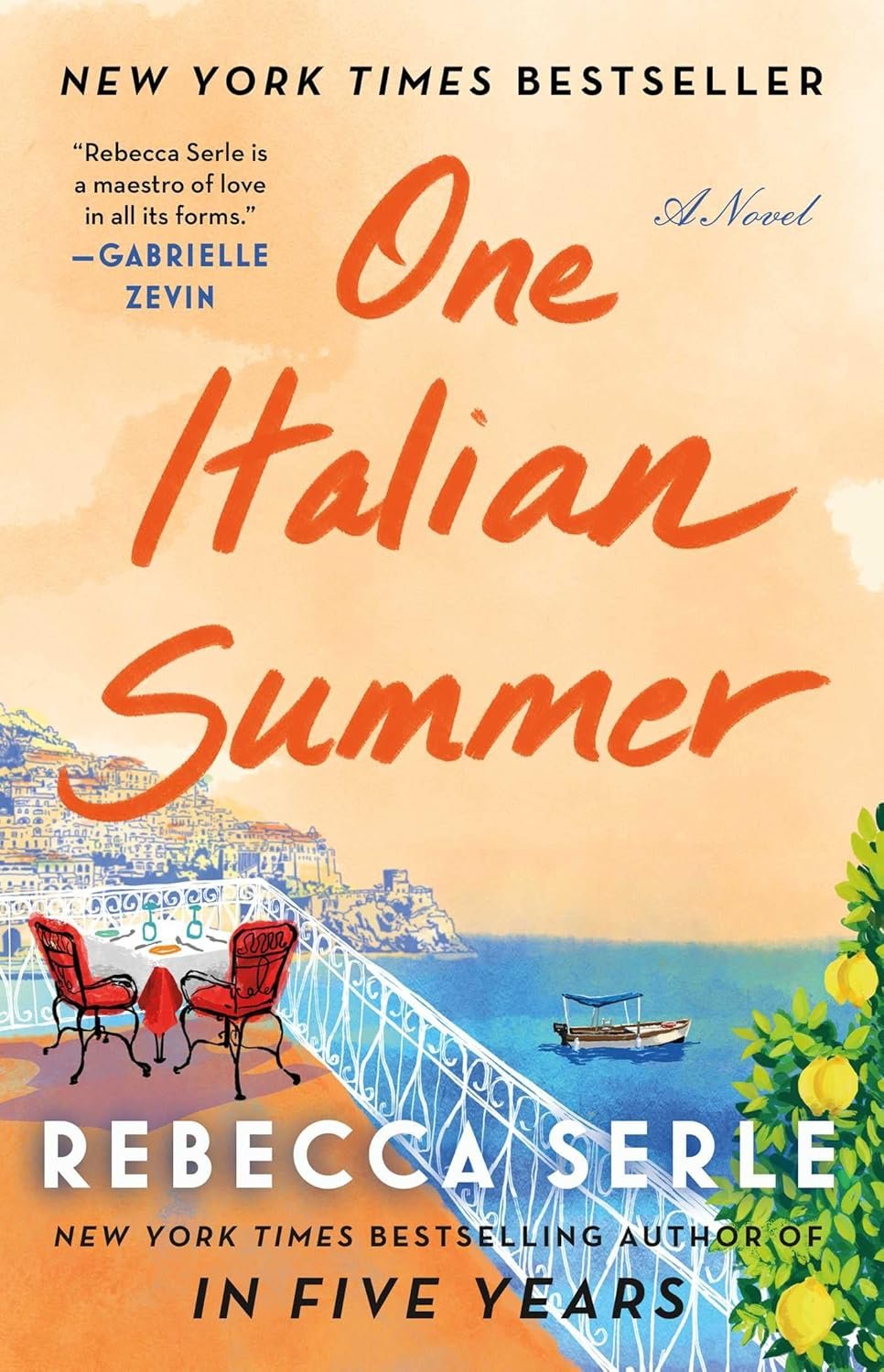
One Italian Summer by Rebecca Serle (Atria Books, 2022) is a novel about a young woman named Katy who travels to Positano, Italy after losing her mother Carol and finds her there, impossibly, thirty years old and alive. This is a personal review on what the book gets right about grief, identity, and becoming, and where the magical realism falls short.
I picked up One Italian Summer expecting: Italy, sunshine, grief wrapped in something warm because the story follows Katy, a young woman who travels to Positano after losing her mother, and finds something she wasn't expecting. There were parts I genuinely resonated with but the execution of the central premise didn't work for me, and that colored a lot of my experience reading it. Here's what stayed with me:
The genre and the promises a book makes
I’ve learned that I can't stay fully invested in a book that starts in the real world and becomes fantasy without setting that up properly from the beginning. I need a book to pick a lane or skillfully move between lanes. If it's fantasy, I'm in, even when the world looks like ours or goes between our world and another. If it's grounded in reality, I'm in, even when characters fall apart, hallucinate, or spiral.
The back cover of One Italian Summer does tell you something unusual is coming: Carol, Katy's mother, appears in the flesh, impossibly, and that Katy gets to know her in this new form without understanding how or why. So, it's not like the book hides anything. But knowing something strange is coming and actually being brought into it convincingly are two completely different things.
The book opens with grief, with the specific weight of losing a mother, and it feels like a real-world story. When it changes, even with the back cover warning, it actually feels like a disruption rather than a natural part of the world the book had built. By the time I understood what was happening, I had already lost interest in the connection. I don't think this makes the book bad. It makes it uneven. If the magical elements had been woven into the fabric of the story from the start more skillfully, not just flagged on the back cover, I think I could have adjusted. Without that, I spent a chunk of the book just accepting the rules in order to finish the book rather than being immersed in them.
Becoming and the traps we build around ourselves
Underneath all of that, this is really a book about becoming. And on that front, it delivers.
Early on, Katy reflects: "We built a life that perhaps we are too young to live... I had always felt more comfortable in the presence of adults than young people, had felt since the time I was 10 years old that I was one. And I wanted all the trappings that would signal to others that I was one, too. It felt right to start young."
So much of adulthood is exactly that. A trap. A long performance of pretending that the things we were told to want are actually the things that make us feel alive. Checking the boxes, hitting the milestones, building the life that looks right from the outside. This book is about what happens when that starts to fall apart, when you have to figure out who you actually are underneath all of it.
A few pages later, Katy cements that thought: "We made promises in a world lit with light. We do not know how to keep them in the darkness."
I sat with that line for a while. How many decisions have we made in a good season, a stable moment, a version of our lives that felt solid that just don't hold when things get hard? Katy's whole life is built on those kinds of promises. And this book makes her look at every single one. I think about this a lot in my own life, whether the things I'm committing to are things I can actually honor when it stops being easy. I've learned that question changes how you make decisions by helping you slow down and be more intentional. But there's also a balance because sitting with that question too long can become its own kind of avoidance, a way of letting the fear of making the wrong decision stop you from making any decision at all.
Leaving things behind to get where you need to go
Later in the book, Katy hears something that I think is really the whole point: "What got you here won't get you there... that same set of circumstances, beliefs, actions that got you to a moment won't get you to what comes next. That if you want a different outcome, you have to behave differently. That you have to keep evolving."
This is the hardest part of becoming because growth is not always enticing. Sometimes it means leaving things behind, mindsets, habits, and sometimes people. Not always, and not without grief, but sometimes. And the scariest part is that what you're leaving behind is usually something familiar, something that once worked, something that felt like safety. This is brought up again, in another moment: "There is more to life than just continuing to do what you know." Which sounds obvious until you realize how much of your life you've built around exactly that, continuing to do what you know because it's easier than sitting in the uncertainty of something new.
I don't sit still in uncertain moments well at all. I spiral, I move, I look for the next solution before the current one has even had time to breathe. But even in the chaos of that, I've learned more about myself and experienced more of life than I ever would have by staying comfortable. One of the biggest disconnects I feel with people is meeting those who aren't willing to take those risks at all, who stay so comfortable that the question Katy eventually asks herself never even comes up: "What if I got it all wrong... what if we never got to where we were trying to go because we were so comfortable where we were?"
Comfort is its own kind of trap. Sometimes the thing keeping us from becoming isn't a lack of opportunity or ability. It's just that where we are feels familiar enough to stay. So, when Katy is finally out, living, letting herself exist outside the weight of loss and says "I feel the decade of playing grown-up clawing at me, all the years not spent getting drunk on dance floors presenting themselves here, tonight", I was cheering for her. Yes, it's avoidance in the technical sense, but some of us have to go back and give ourselves the experiences we skipped. It's not regression. It's a kind of rebellion against the life we thought we were supposed to have. A way of grieving not just a person, but a version of yourself that never got to exist.
“Even inaction is a choice”
A huge lesson I have learned that was reiterated as a theme in the book is that every yes you give is a no to something else. I learned this most clearly working in corporate environments but I’ve started to apply it to every part of my life. For example: when you say yes to every request at work, you're losing the ability to recognize what actually matters. When you say yes to staying comfortable, you're saying no to growth. The cost of it goes largely unexamined because many people around us are doing the same thing: letting the noise decide our priorities or letting comfort decide our life. And that, without ever realizing it, is still a choice.
The character who quietly stole the book
I love Katy's mother. Carol Silver is someone I found myself genuinely drawn to, not because she was perfect, but because she showed up for her life. She enjoyed ordinary days. She arrived places with real excitement. She just seemed to love whatever phase of life she was in.
This is something I actively struggle with. I am almost always looking ahead, restless with where I am, wondering what comes next. Katy, before her transformation, was almost the opposite of me and Carol, she just accepted life as it came. Little passion, little curiosity. She simply was. I've been jealous of people like that. And I've also wondered whether that kind of stillness is actually peace or just fear dressed up as peace. What I do know is that Carol was neither of those things. She wasn't still out of fear and she wasn't restless like me. She just lived even when her life was complicated or painful.
The story of Carol's creative life – her design work treated as a hobby, her ambitions set aside – is heartbreaking. Throughout the book, Katy comes to realize how little she actually knew of her mother's inner world. How much Carol wanted and couldn't reach because of financial pressure, family responsibility, the slow accumulation of a life that needed tending. It's like wearing a weight vest on your chest, and ten pounds added every year that passes without doing the thing you actually wanted to do. And I imagine as women become mothers, that weight gets even heavier because their desires often get dismissed along with it.
This hit me personally. Coming from an immigrant background, I know what it feels like when the things you want have to come second because of financial pressure, because of family responsibility, because stability has to come first. I could feel the weight Carol was carrying. It's hard to give up what you know you want to do but can't. And it made me feel unexpectedly close to her.
Which is maybe why the scene with Marco hit me the way it did. When Katy tells him she lost the person she was meant to come to Positano with, he says: "Positano is a good place to let life return to you." She mentions, she doesn't know how. And he responds: "In time, you will discover. And in the meantime, enjoy."
Carol understood this. That was the thing about her. She knew how to be where she was. How to enjoy the ordinary day, the mundane moment, the phase of life she was actually in rather than the one she was waiting for. I'm still learning that. There are still parts of my life waiting to return to me and the hardest part isn't the not-knowing. It's being unable to enjoy what's right in front of me while the not-knowing is still happening but I'm working on it.
Should you read this?
Reading back through everything that stayed with me, I clearly got a lot out of it too. The emotional depth is real, especially in Katy's relationship with her mother, and the themes around grief, identity, and becoming are handled with a lot of care. While it is not on my re-read list, if you can set aside the way the magical elements are executed, or if that kind of thing just doesn't pull you out of a story the way it pulls me out, there is genuinely a lot here.
Other lines that stayed with me
"It's hard to be good at something that you don't love."
"I find that beauty next to decay is its own kind of stunning."
"It's a place that once was glorious and carries the memory not as a chip, but a promise. Again, someday."
"It's our relationship — not everything has to make sense to you. It's what we both want."
"What if I got it all wrong. What if the point of marriage wasn't to belong but instead to feel transported? What if we never got to where we were trying to go because we were so comfortable where we were?"
"Unlike America, progress is rated differently. It happens slower."